THE March interest rate decision holds strong importance as rates influence the economy through three main factors: the cost of borrowing, monthly bond repayments, and the confidence levels of households and investors. The South African Reserve Bank (SARB) is set to announce the March interest rate decision on Thursday afternoon, according to IOL.
Lower Inflation And Borrowing Costs Improve Affordability
Currently, South Africa’s repo rate stands at 6.75%, while the prime rate is at 10.25%. Headline Consumer Price Inflation (CPI) dropped to 3.0% in February 2026 from 3.5% in January, according to Ezra Rasethe, CEO of investRand.
He explains that this situation would typically support the property market, as reduced inflation and borrowing costs improve affordability. However, the Monetary Policy Committee (MPC) still needs to consider global risks such as oil prices and currency volatility.

Rasethe adds that for the property sector, the decision mainly affects behaviour. It determines whether buyers move forward now or wait, and whether investors choose to invest or stay cautious.

Data Indicates Property Market Recovery Phase
investRand states that current data already signals a recovery phase. Market sentiment is improving, activity is gradually increasing, and pricing remains relatively stable.
The Absa Homeowner Sentiment Index rose to 87% in Q4 2026, one of the highest levels recorded. This shows that households are becoming more positive about buying, selling, and investing in property
At the same time, pricing remains controlled. Lightstone’s Property Index shows national house price inflation at 3.4% year-on-year, while Stats SA data reports Johannesburg freehold growth at 6.2%. This suggests a recovery phase rather than a rapid speculative increase.
March Decision Seen As Confirmation, Not Turning Point
Rasethe notes that the March decision is not a turning point but a confirmation of ongoing recovery. He highlights that the recovery has already begun and that 2026 may offer a key opportunity for entry before stronger price growth takes place.
Considering global conditions, investRand believes the best outcome would be to keep rates unchanged with a slightly supportive outlook instead of making aggressive cuts.
Although February inflation at 3.0% supports easing, global uncertainty remains due to rising oil prices, currency fluctuations, and geopolitical risks.
Analysts increasingly expect SARB to hold rates due to these external pressures, while still anticipating gradual easing in the medium term as inflation stabilises further.
Stability And Predictability More Important Than Rate Cuts
investRand emphasises that in uncertain markets, predictability matters more than immediate stimulus. SARB’s role is not only to lower rates but also to maintain credibility.
 Full SASSA Grant Payment Dates 2026/27: Financial Year Schedule Released For Beneficiaries
A sudden or aggressive rate cut in a volatile global environment could weaken that credibility, while a steady and consistent approach strengthens confidence across the economy.
From a property perspective, Rasethe explains that this stability is more valuable than rate cuts themselves. Property markets respond strongly to clear guidance and consistency.
If SARB signals that inflation is under control and future easing is possible, it creates the certainty needed for buyers and investors to take action.
He further adds that lower rates alone do not drive property markets—confidence does. And confidence comes from consistent policy direction rather than reactive decisions.
Strong Demand Supports Property Sector Resilience
According to investRand, the South African property market is supported by strong structural demand. There is consistent demand for rental housing, affordable housing, and well-located urban properties. This demand provides stability even during global uncertainty. However, maintaining resilience requires discipline. Buyers must focus on affordability and avoid excessive borrowing, ensuring investments remain sustainable under different interest rate conditions.
Interest Rate Hold Expected With Future Easing Signals
Maphefo Sipula, Head of Research and Impact at Property Point, says SARB is expected to keep rates unchanged in March while indicating a gradual easing path later in the year.
This approach balances inflation risks with South Africa’s slow economic growth and limited investment environment.
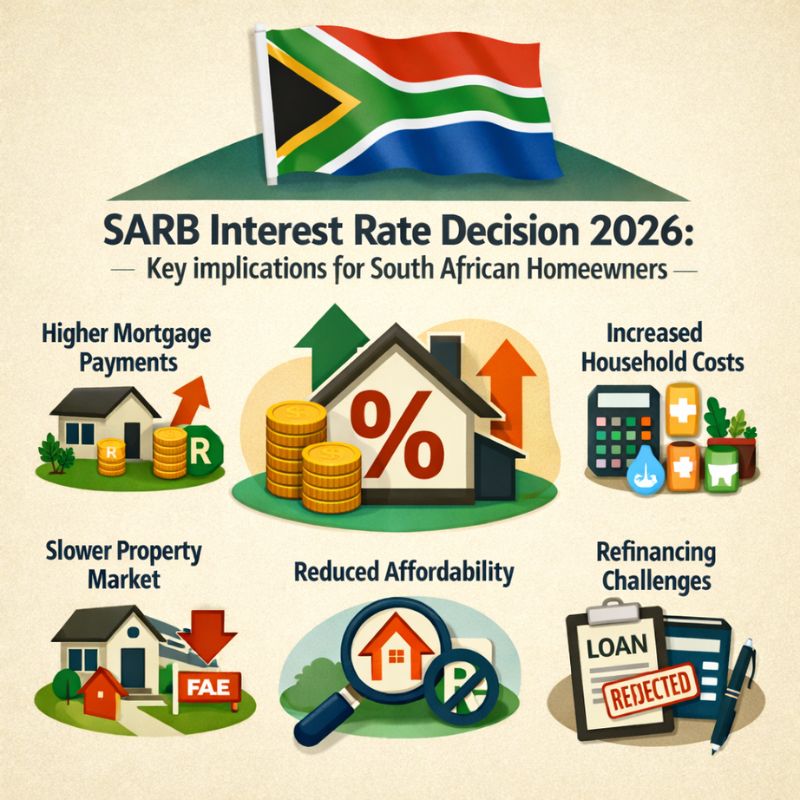
While a rate hold may extend short-term pressure on the property sector, clear signals toward future cuts can provide the certainty needed for planning, investment, and recovery.
High Borrowing Costs Still Challenge Property Businesses
For the property sector, especially small businesses supported by Property Point, current conditions remain difficult but not without opportunity. High borrowing costs continue to restrict access to finance, delay projects, and reduce profit margins for small developers, contractors, and service providers. However, the expected shift toward lower rates creates an opportunity for strategic preparation. Businesses that remain financially disciplined, efficient, and well-connected can position themselves for the upcoming recovery phase.