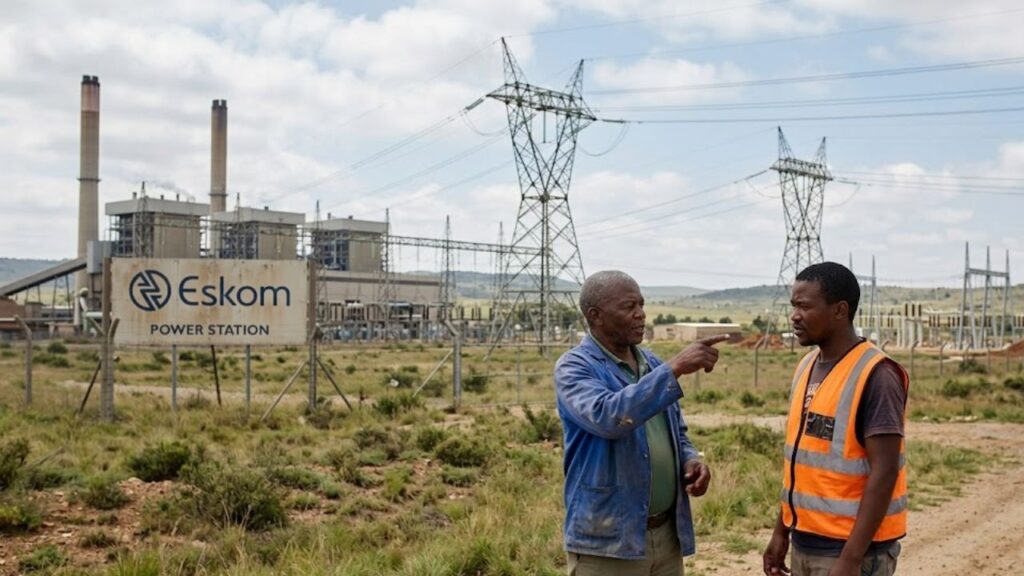
South Africa’s electricity sector is set to undergo a major transformation, with Eskom’s long-standing monopoly expected to end. A key milestone in this transition is planned for the third quarter of 2026.
History of Eskom
Eskom was originally established in 1923 as the Electricity Supply Commission (ESCOM) under the Electricity Act of 1922. It was founded by Hendrik van der Bijl with support from Prime Minister Jan Smuts, aiming to deliver affordable and reliable electricity to boost industrial growth.
Initially operating as a non-profit public utility, Eskom gradually absorbed private electricity providers to centralize the national grid.
 Full SASSA Grant Payment Dates 2026/27: Financial Year Schedule Released For Beneficiaries
Growth and Expansion
Between the 1960s and late 1980s, Eskom experienced rapid expansion to meet increasing energy demand. It became known for constructing large coal-fired power stations with six generating units.
However, due to economic slowdown in the 1980s, Eskom ended up producing excess electricity, forcing it to shut down several operational plants.

Post-1994 Developments
After 1994, Eskom shifted focus toward electrifying underserved communities. Despite this, it failed to keep up with growing electricity demand.
The government rejected proposals to build new power plants, expecting privatization instead. This delay led to a major energy crisis.
Start of Load Shedding
In 2007, South Africa faced severe electricity shortages, leading to the introduction of load shedding to prevent a total grid collapse.
Over the next 17 years, Eskom struggled with:
- Poor management
- Corruption
- Political interference
These issues weakened its ability to supply reliable electricity.
Ending Eskom’s Monopoly
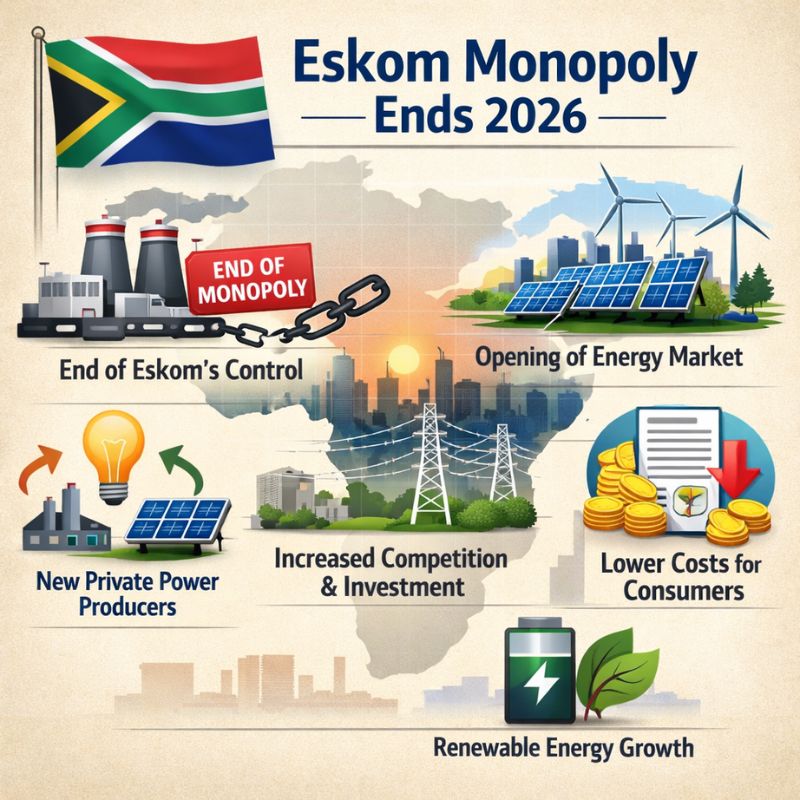
To fix these challenges, the government introduced reforms to make the electricity sector more competitive.
The Electricity Regulation Amendment (ERA) Act, effective from 1 January 2025, aims to restructure Eskom by splitting it into three independent divisions:
- Generation
- Transmission
- Distribution
This change is designed to remove Eskom’s full control over the energy supply chain.
New Market Structure
A new entity, the National Transmission Company South Africa (NTCSA), will manage the national grid and ensure fair access for all power producers.

The South African Wholesale Electricity Market (SAWEM) is expected to launch in Q3 2026, slightly delayed from the original April timeline.
Benefits of Reform
The new system is expected to:
- Increase competition
- Improve efficiency
- Lower electricity costs
- Attract investment
- Strengthen long-term energy security
Resistance and Challenges
Despite reforms, Eskom has resisted losing control, especially over transmission assets.
Experts argue that:
- Keeping the grid under Eskom limits competition
- It discourages private investment
- It weakens reform efforts
Some key concerns were raised by industry experts and business leaders regarding Eskom’s commitment to change.
Government Intervention
During the State of the Nation Address on 12 February 2026, President Cyril Ramaphosa announced that the transmission system would become fully independent.
A new Transmission System Operator (TSO) will be created as a state-owned entity, separate from Eskom.
Future Roadmap
To manage the transition, a National Energy Crisis Committee (NECOM) task team has been formed.
This team will:
- Develop a final restructuring roadmap
- Ensure Eskom’s financial stability
- Oversee the transfer of assets
The final report is expected in May 2026.
Summary Table
| Aspect | Details |
|---|---|
| Establishment | 1923 as ESCOM |
| Initial Purpose | Provide cheap, reliable electricity |
| Major Expansion | 1960s–1980s |
| Crisis Start | 2007 (Load Shedding) |
| Reform Act | ERA Act (2025) |
| Structural Change | Split into 3 entities |
| New Grid Operator | NTCSA |
| Market Launch | SAWEM (Q3 2026) |
| Key Goal | Competitive electricity market |
| Current Challenge | Eskom resistance to reforms |
Conclusion
South Africa is moving toward a competitive electricity market by breaking Eskom’s monopoly. While reforms promise better efficiency and investment, challenges remain in ensuring full independence and smooth transition of power sector control.